Do you know the concept of Chris Anderson? The concept gives you some great insights in the way technology is changing industries, particularly the entertainment industry.I would like to share with you a summary of the Long Tail concept:
"The theory of the Long Tail is that our culture and economy is increasingly shifting away from a focus on a relatively small number of "hits" (mainstream products and markets) at the head of the demand curve and toward a huge number of niches in the tail. As the costs of production and distribution fall, especially online, there is now less need to lump products and consumers into one-size-fits-all containers. In an era without the constraints of physical shelf space and other bottlenecks of distribution, narrowly-target goods and services can be as economically attractive as mainstream fare.’
Or watch this video about the Long Tail:
Kevin Kelly, at Wired, who had some nice observations about The Long Tail and the profitability of products: 'Seth Godin has been exploring Chris Anderson's idea of the The Long Tail. As usual Seth brings clarity and illumination to this often misunderstood notion. He recently posted a dissection of the three "profit pockets" within the Long Tail, which he illustrated like this:
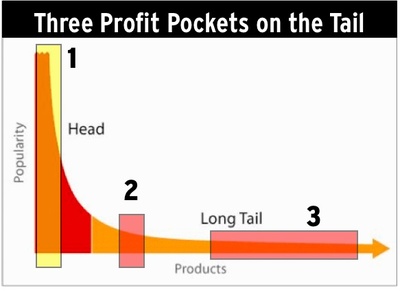
There's a blatant switcheroo that Seth (and almost everyone else) makes when explaining the Long Tail. In pocket #1 of the curve, Seth talks in terms of a creator of a work. In pocket #2 of the curve, he also talks in terms of the creator. But then when he gets to the long tail, he switches away from a creator, to talk in terms of an aggregator of other creators' work. Why is that? What happens to the creator? The creator is dropped when we get to the long tail "pocket of profit" because the long tail is not profitable for the creator. It's profitable only for the audience and aggregators.'
 Een blog. Leuk, maar wat zet je nu op je blog. Mijn blog gaat voornamelijk over de muziekindustrie. Maar, niemand kan verifiëren of de informatie die ik vermeld klopt.
Chris Anderson schrijft hierover in zijn boek de Long Tail het volgende:
"Het verzamelen van betrouwbare kennis is altijd het werk van geleerden geweest. Het begon met een paar veelweters die het onmogelijke probeerden. In het oude Griekenland vatte Aristoteles het plan op eigenhandig alle kennis uit zijn tijd vast te leggen.Vierhonderd jaar later produceerde de Romeinse edelman Plinius de Oudere een 37-delige encyclopedie met de kennis uit zijn tijd.
Jimmy Wales introduceerde in januari 2001 een ander model, het open collectief. In plaats van één of een paar echte slimme jongens, trekt Wikipedia tienduizenden mensen van allerlei pluimage aan - variërend van echte deskundigen tot geïnteresseerde leken. Een heleboel vrijwillige beheerders nemen nieuwe artikelen onder hun hoede en houden de ontwikkelingen ervan in de gaten. Volgens Wales' encyclopedische rekenmethode staan vijftigduizend zelf benoemde Wikipedianisten gelijk aan één Plinius de Oudere."
Op de vraag of de informatie van Wikipedia betrouwbaar is is volgens Anderson ook geen eenduidig antwoord te geven. "Wikipedia werkt volgens de onbegrijpelijke logica van de waarschijnlijkheidstatistiek, net zoals Google en andere op talloze blogs gebaseerde collectieve kennis."
Ook ik wil een bijdrage leveren aan het vergroten van kennis, in dit geval kennis over de muziekindustrie. Toch vind ik een blog een raar fenomeen. Je schrijft over een onderwerp dat je zelf interesseert en waarover je graag iets kwijt wilt. Maar, wie zit daar eigenlijk op te wachten?


 Posts
Posts


