"The theory of the Long Tail is that our culture and economy is increasingly shifting away from a focus on a relatively small number of "hits" (mainstream products and markets) at the head of the demand curve and toward a huge number of niches in the tail. As the costs of production and distribution fall, especially online, there is now less need to lump products and consumers into one-size-fits-all containers. In an era without the constraints of physical shelf space and other bottlenecks of distribution, narrowly-target goods and services can be as economically attractive as mainstream fare.’
Or watch this video about the Long Tail:
Kevin Kelly, at Wired, who had some nice observations about The Long Tail and the profitability of products:
'Seth Godin has been exploring Chris Anderson's idea of the The Long Tail. As usual Seth brings clarity and illumination to this often misunderstood notion. He recently posted a dissection of the three "profit pockets" within the Long Tail, which he illustrated like this:
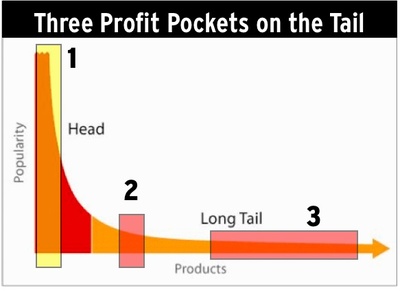
There's a blatant switcheroo that Seth (and almost everyone else) makes when explaining the Long Tail. In pocket #1 of the curve, Seth talks in terms of a creator of a work. In pocket #2 of the curve, he also talks in terms of the creator. But then when he gets to the long tail, he switches away from a creator, to talk in terms of an aggregator of other creators' work. Why is that? What happens to the creator? The creator is dropped when we get to the long tail "pocket of profit" because the long tail is not profitable for the creator. It's profitable only for the audience and aggregators.'


 Posts
Posts


No comments:
Post a Comment